
Evolution of Reflektive: We’re Now Part of PeopleFluent and LTG
In 2014, Rajeev Behera, Erick Tai, and Jimmie Tyrrell founded Reflektive to bridge the feedback gap between managers and employees. Reflektive has since become a recognized leader in performance management by G2, Brandon Hall Group, TalentCulture, and Gartner. Forward-thinking companies such as Allbirds, FabFitFun, Grubhub, and Protective now depend on Reflektive to align goals and scale constructive, ongoing conversations that increase their employee engagement and productivity by 2X.
Today, Reflektive enters the next phase of its innovation and growth. Learning Technologies Group plc (LTG), the parent company of PeopleFluent, has signed an agreement to acquire Reflektive. Reflektive’s complementary performance management capabilities will be part of PeopleFluent’s talent management portfolio, enhancing its engagement and analytics capabilities.
Addressing the Modern Talent Journey
The shift to remote work due to COVID-19 has meant adapting to business today by reimagining the customer experience for tomorrow. As part of PeopleFluent, our customers will be able to utilize a single solution for recruitment, talent mobility, performance, compensation, succession, and learning, as well as organizational charting. The Reflektive and PeopleFluent solutions will work together or separately to connect the modern talent journey – to recruit top talent, identify skills gaps, provide opportunities to learn, and define paths for career growth.
People analytics presents one of the most exciting innovation opportunities for the combined companies. This last year, people leaders looked to use data to inform employee engagement; employee experience; diversity, equity and inclusion; and remote work. Integrating Reflektive and PeopleFluent technologies will bring together a comprehensive view of the employee experience to measure progress and engagement. Richer data of over 25 million users will also accelerate artificial intelligence-based predictions and automated processes. In the future, PeopleFluent customers will be alerted about risks and opportunities in their organization, such as a potential drop in engagement within a department or an employee at risk of leaving.
Part of LTG
As part of LTG, PeopleFluent offers world-class service and an unparalleled ecosystem of partners to more than 1,500 customers across more than 200 countries worldwide, including NBCUniversal, Schwan Foods, Johnson Controls, Comcast, and Shell. PeopleFluent’s resources and global scale will support the growth of Reflektive customers.
We are excited about this opportunity and what it means for Reflektive, PeopleFluent, and our joint customers. Our combined technologies are poised to transform talent management so our customers can transform their businesses.
Learn more about our acquisition by reading the LTG and PeopleFluent press releases, and for our customers, stay tuned for updates from your customer success team.
Calibration at Reflektive: New Offering & Best Practices for HR Teams
Calibration. A big word for a complex process.
Whether you’re aligning on performance reviews or selecting future company leaders, calibration is often an emotionally-charged term. Calibration has historically been a manual, frustrating process for all involved. And it often doesn’t accomplish its objectives — eliminating biases, addressing ratings inconsistencies across teams and managers, and adding clarity to talent management decisions.
For years, companies have either endured the time-consuming and sometimes ineffective process – or scrapped it all together.
It’s no wonder that calibration brings frustration and fear to mind — when was the last time a calibration session left you feeling empowered?
A New Start: Calibration in 2021
But what if we turned traditional calibration into a modern, data-driven process—one that not only saves time, but also incorporates multiple data sources to create a more complete, unbiased view of performance and talent?
We’re excited to announce Reflektive Calibration is coming soon!
This solution helps HR teams by:
- Improving calibration quality with helpful information all in one place
- Ensuring rating consistency and data integrity, so organizations can make the optimal talent management decisions
- Saving time for HR professionals and managers, so they can focus on other strategic priorities
What makes our solution unique is that it incorporates employee feedback and recognition, so managers have a broader understanding of performance over time instead of anchoring on the most recent performance anecdotes. Reflektive Calibration supports annual, quarterly, monthly, and even on-demand calibration sessions.
We’ve heard from several customers that they appreciate having one go-to place for all performance data. Specifically, they like being able to:
- Visualize distributions for performance and talent ratings, including the 9-box grid
- Have easy access to decisions and comments from calibration sessions
Our early adopters have also benefited from the solution’s ease of use and time savings. Per Taylor Orr, Learning & Org Development Program Manager at Dropbox, “The ROI of Reflektive Calibration is definitely there for me. With our previous manual process, I had to export all our data, blend it with demographic data, upload it into our calibration system, and export the results to be uploaded back into Reflektive. It was a massive effort, and a huge time drain. With Reflektive, I didn’t have to do manual work — instead I was able to spend more time enabling HRBPs to have successful calibration sessions.”
But technology alone can’t drive an improved calibration process — it takes effective leadership and communication to ensure that performance and talent planning are equitable. Below are some common questions we receive from customers, and the best ways to drive calibration forward.
Calibration FAQs
Pre-Calibration
– Start with useful data from your performance reviews. To ensure that your reviews are providing valuable information, check out our Guide to Launching Reviews & Check-Ins.
– Determine calibration objectives (e.g., talent planning, deciding on promotions, assigning fair performance reviews)
– Prepare calibration data, such as review ratings, 9-box ratings, feedback, and recognition (Reflektive customers can easily add and manage calibration data in a customizable table!)
– Share data with calibration session participants. Ask participants to look for employee performance trends, and flag inconsistencies, prior to the calibration session.
– Determine number of calibration sessions needed based on number of managers and seniority
– Schedule calibration sessions for each division and level as needed. In email invite, remind attendees of:
– Objective(s) of calibration session
– Framework for how ratings should be determined
Calibration Session
– Recap objective and set ground rules
– Recap ratings framework
– Share-out ratings trends observed, as well as key areas that need to be addressed
– Discuss employee performance, including whether ratings should be modified
– Review each participant’s ratings distribution to see if it is “normal”. If ratings do not fall into a bell curve, discuss why not.
– Adjust ratings as needed
Post-Calibration
– Send a follow-up email communication with session participants
– Update records with calibrated values (this can be done in one click with Reflektive!)
– Use calibrated ratings as input for bonuses or other pay for performance systems, if applicable
– Ensure everyone is at the same level in the meeting, so participants will feel more comfortable speaking up
– Break up into smaller groups if meeting is too big, to give everyone a chance to speak
– Set ground rules, e.g., everyone will have a turn to speak and no one will be interrupted
– Set start time and end time to drive focus and completion of desired session goals
– Select a time that works for everyone
– Ensure that your group is focused on only one objective (e.g., performance ratings or talent planning) to make the best usage of time / effort
– Prioritize discussion time on performance outliers — start with employees that scored very high or very low before moving to the middle
– Ensure that all participants have their completed assignment before the session
– Mute backgrounds so people can focus on the current speaker
– Recency bias – focusing on recent performance rather than an employee’s performance over the longer-term
– Primacy bias – the opposite of recency bias — managers place a higher value on first impressions rather than overall performance
– Affinity bias – when managers have a more favorable view of employees with similar backgrounds to them
– Gender bias – when managers have a more favorable view of men versus women
– Examine ratings distribution data to see if different employee demographics are more likely to receive high ratings or low ratings
– Educate managers and employees on different types of biases, and how biases manifest themselves
– Run pulse surveys to identify areas of opportunity at your workplace
– Identify biases in performance programs, and develop plans to remedy them. Common places for bias and best practices to address them are in this blog post.
– More ideas for detecting and defeating unconscious bias are available in this how-to guide
Interested in early access to Reflektive Calibration? If you’re already a Reflektive customer, reach out to your customer support team. If you’re not currently a Reflektive customer, schedule a chat with an expert.
Author: Marc Caltabiano, Chief Product Officer
Reflektive Customer Series: Elevate and Evolve at FabFitFun
FabFitFun is a lifestyle membership company that delivers well-being and happiness via their iconic box. We sat down with Will Feng, Director of Learning and Organizational Development, for a discussion on how he’s boosting employee morale, engagement and performance at FabFitFun during these changing times. Will shares a number of best practices, and closes with important considerations when launching new people programs.
Interested in learning more about how Reflektive can support your business? Schedule a consult with an expert.
How unprecedented times brought us closer together – and increased our engagement score by 13%
My brothers and I used to play a board game called “Pandemic”, where we each were assigned a role to play in stopping the spread of a dangerous virus before it became a pandemic. Together we had to work to protect people across countries from getting the virus, and it was a very difficult game to win. Never did we think this game was reflective of what was to come in 2020. Never did I think about what my role as a HR leader would actually need to be, if a pandemic were to actually happen.
When I look back over the past six months, working with the Executive Team at Reflektive, I am extremely proud of the role that every executive, manager and employee played to make us even more resilient and empathetic toward one another. None of us had a playbook of how to navigate this time; no one in the world does. However, we knew the most important ways to get started: keep our minds open, listen, ask for feedback and take action.
This is how we continued to build a close knit, inclusive, and open culture — even while all Reflektors were working remotely during the pandemic. During this unprecedented time, I’m proud to say that we solidified our corporate culture. Reflektive’s overall engagement score increased by eight points, and two areas that drive the most engagement at our organization increased by an average of 19 points. How did we do it during extremely difficult global conditions? I’ve included the top seven ways that helped us strengthen our corporate culture.
- Measure sentiment during onset of COVID
When we first went remote, we had to quickly figure out how to best support our employees in a newly remote environment. We ran a survey to learn how the transition went, how supported our employees felt by the company and their managers, and if they had what they needed to do their best work. We made several changes based on feedback we heard. When we ran the same survey six weeks later, we found positive improvement, and our employees were grateful to have a forum to voice their needs.
- Create regular communication forums
As COVID-19 rapidly began to spread, our Employee Success and Executive teams met to discuss how we can keep our employees connected. We decided on:
- A weekly Fireside chat with our CEO to provide company updates
- Weekly office hours with our executive team members
- Regularly scheduled team stand ups
- Frequent informal social hours
- A virtual social calendar listing activities around the world to participate in.
As time progresses, we continue to assess and adjust this frequency so that it aligns with employee needs.
- Drive productive manager-employee conversations
A huge focus has been to ensure managers and employees are having high-quality conversations on a regular basis. We created “Working Remotely” Conversation Starters that our managers and employees can use to prompt conversations that may not naturally happen in a 1:1 meeting. Some of those Conversation Starters include “How can I best support you while we continue to work remotely?” and “Are there any risks to your achieving your goals? How can I support you?” Prompting important topics is key in helping our employees to feel supported and motivated during this challenging time.
- Form an employee DEI Task Force
When the killings of George Floyd, Tony McDade, Amad Arbery, and Breonna Taylor happened, our CEO wrote a note first to our company, and then to our customers about our stance against racial injustice and our support of Black Lives Matter. We held an open conversation with the company the day after he sent the memo, and also organized donations, which we matched, to organizations to support causes against racial injustices. We were happy to receive an influx of ideas from our employees on how Reflektive could be even better in the areas of diversity, equity, and inclusion. We gladly welcome this input, and formed a DEI task force of 20 employees interested in helping the company define focus areas. We ultimately decided to focus on four areas:
- A company audit to determine where we could improve company practices
- Our product and ensuring we take a DEI lens on our product design
- DEI Conversation Starters that drive meaningful 1:1 conversations about the topic among employees and managers
- Education about Votership.
This task force has met regularly and made significant progress in a short period of time, bringing in a DEI consultant to help us, facilitating education about voting, and solidifying DEI conversation starters. I am looking forward to continuing these efforts with this talented team at Reflektive.
- Run a gratitude campaign
“Gratitude for the present moment and the fullness of life now is the true prosperity.” – Eckhart Tolle
As Michelle Wax, founder of The American Happiness Project, shared at our Virtual Sales Kick Off, gratitude is a big component of building resilience during difficult life situations. To help employees build resilience, our Employee Success team launched a gratitude campaign in June. In this campaign, we prompted employees to share gratitude for their colleagues on Reflektive’s Recognition Wall. We saw overwhelming responses to our weekly question prompts, including “Who/what has made you laugh or smile this week?” “What’s one thing someone did recently that made your job easier?” This focus on positive thinking helped strengthen bonds across our workforce.
- Create organizational clarity
COVID has caused widespread uncertainty for employees. With such uncertainty, our executive team felt it imperative to create a “Reflektive Playbook” that aligns the company around our mission and vision. We addressed five simple yet impactful questions including:
- What do we do?
- Why do we exist?
- How will we succeed?
- What’s most important right now?
- How do we behave?
With guidance from Patrick Lencioni’s organization, The Table Group, we articulated brief and clear answers to these questions, and have spent time communicating them regularly to our organization. This has kept us hyper-focused and aligned as we ride the bumpy waves of economic uncertainty.
- Build manager strength
Knowing that managers play a significant role in our daily happiness at work, Reflektive invests heavily in building manager skills. Our focus areas over the past six months included:
- Addressing employee mental wellness
- Managing remotely
- Leading productive remote check in conversations
- Building resilience.
In these workshops, not only do we teach core principles, but we also create a forum for managers to share their own best practices and learn from each other. Most importantly, we want to make sure our managers can help support one another as they play crucial roles managing our employees every day. Having a great manager during this tumultuous time is critical, and we want to know we’ve done everything within our power to support and motivate our employees.
The best way an HR leader can gauge progress of engagement efforts is through employee feedback. Our Employee Success and Executive teams are very proud to see that the hard work put into supporting our culture have proven successful from our employees’ perspectives. I’d like to end with a few great quotes that our awesome employees have shared in a recent survey:
I am very grateful to be working with kind, thoughtful, and intelligent people who support and believe in one another, which honestly means the world to me!
I’m very proud of the organization’s resilience through everything in the past year, and think our leaders are truly dedicated to the company’s success.
Manager Guide: Boosting Employee Mental Wellness
The past several months have impacted every aspect of our lives. From how we work, take care of our children, and get groceries, the pandemic has often made life more stressful for people. As a manager, you have the ability to help your direct reports during this unprecedented time. By having frequent 1:1 meetings, listening with empathy, and directing employees to helpful resources, you can help them better cope and navigate the rollercoaster of 2020. Read more for answers to common mental health questions, and best practices to support your direct reports during this time.
What’s on employees’ minds right now?
While the pandemic has had a slightly different impact on each person, there are common themes that arise. Most people feel a loss of control, as they cannot influence the trajectory of COVID-19. Additionally, with shelter-in-place and social distancing measures, people are also feeling isolated during this time.
What impact have these stressors had on employees’ mental health?
Recent data from Healthline and YouGov’s COVID-19 tracker confirmed the toll that the pandemic is taking on mental health. According to the data, “Americans are reporting significant and sustained increases in symptoms of depression and anxiety related to the COVID-19 pandemic”. Compared to 2006, there’s been a 32% increase in the number of people that exhibited some form of depression (from 37% to 49%).
Depression and anxiety are “not always easy to spot,” but depression symptoms can include “feeling sad, empty, or hopeless; having difficulty with day-to-day tasks; increased fatigue; and sleep difficulties”. Anxiety causes people “to worry excessively and find it difficult to control that worry or stop it, even with logic”.
What should I do as a manager?
While many things are outside of your control – such as the trajectory of the pandemic and the actions that your company will take – you can use this time to build empathy with your direct report, and guide them to resources that may help them. Specifically, we recommend the A, B, C’s of Crisis Management. Read below to learn more about this framework.
A. Ask your employee how they’re doing
Frequent check-ins with your employees help to build feelings of support and connectedness. Specifically, employee-driven 1:1 meetings provide a forum for direct reports to discuss what’s top of mind right now. However, given all of the stress and uncertainty that employees are experiencing, managers should feel empowered to ask questions and propose discussion topics as well. Some questions to help you better understand your employee’s current situation and needs are below:
- What is top of mind for you right now – either inside or outside of work?
- Is there anything happening outside of work that you’d like to talk about?
- Are there any risks to you achieving your goals?
More tips for 1:1 conversations are available in our Knowledge Center article.
B. Bring up helpful resources
If you learn that a direct report is struggling with mental health, be prepared to talk to the resources that are available. Set up time with a member of your HR team to review resources, which may include:
- Employee Assistance programs, services, and/or hotlines available from insurance companies
- Policies on both medical and personal leaves of absence
- Wellbeing apps and resources, such as Calm and Headspace
The best practice is not to make recommendations to employees, but to let them know what is available, and share a little more information about these programs and policies.
C. Check-in regularly with your team
There are numerous benefits to having more frequent team meetings during this time. If workers are remote and feeling isolated, video chats with their teammates help drive feelings of connectedness. Team members may also pick up on when someone is stressed, depressed, or struggling.
Additionally, daily team meetings help employees feel more aligned and in-sync — they have better context on key priorities, and know what their peers are working on.
D. Demystify what is going on
In our recent Employee Sentiment Survey, we learned that many employees would like more consistent communication from leadership. Hopefully, your company is having frequent all-hands meetings to provide more transparency to employees. Regardless, cascading down information – and providing a forum for discussion on major company updates – provides employees with an opportunity to ask questions and share feedback. With more visibility and context, employees are less likely to feel “in the dark” and worry.
E. Empathize
Show understanding and support for the employee’s situation right now. Whether this means accommodating a different work schedule or simply listening to them, any way you can “show up” for employees will be greatly appreciated by them.
For more best practices to help you lead and manage your team, check out Reflektive’s blog posts for managers.
Preparing for the Return to the Workplace: Strategic Considerations for Leaders
As companies explore their options to return to the workplace before a vaccine is made available, several factors need to be considered to ensure your employees return to work safely. From city regulations to company culture to individual employee risks, these factors are complex and there is no one-size-fits-all answer.
As you navigate this topic, a Task Force is a good idea to organize information and drive the process forward. The decision to return to your workplace, we believe, should be made by a company’s leadership team. Returning is a life-death decision, and considerations need to be made for both the business and employee safety.
This guide outlines key decision points for your leadership team to help you make a Return to Workplace (RTW) decision. We have also included guidance for establishing new protocols at the office with references from other thought leaders on RTW sources.
Reflektive Return to Work Decision Tool
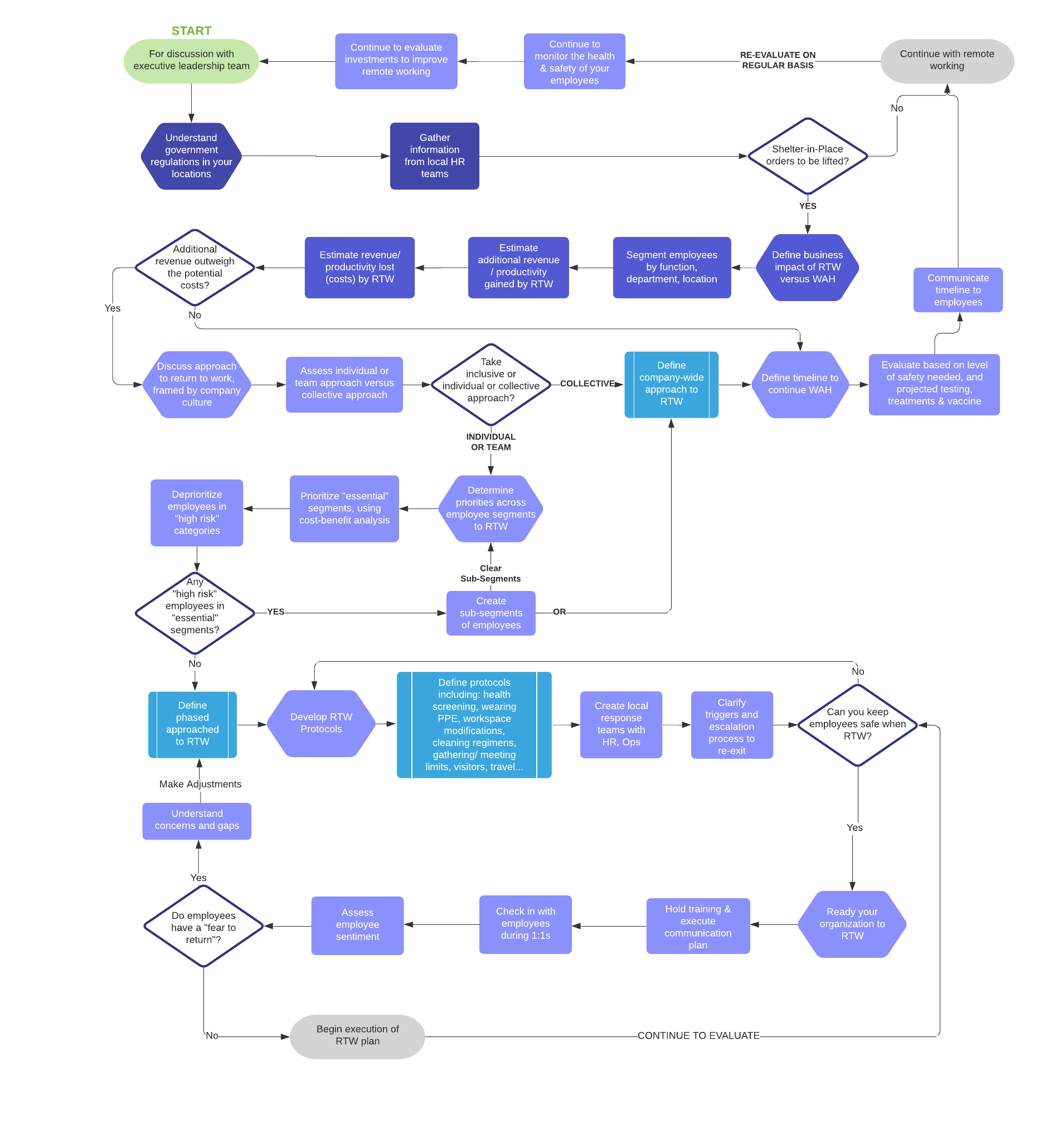
Start with Local Regulations
Local regulations will dictate when your office, factory, restaurant, etc. can re-open. Work with your Task Force and/or your local HR Team to understand regulations across each country, state, city, and local community. Be sure to consider a wider circumference than your place of work itself to include employees commuting.
Determine the Business Impact of Returning to Work vs. Working from Home
A cost-benefit analysis of remote work will vary based on your industry, workforce, access to technology, and location. In a COVID-19 Sentiment Survey by over 7,000 employees using Reflektive we found some unique differences. Here’s a framework to guide your decision-making process:
1. Segment your organization by department, role, and location
The business impact of working remotely can vary. Tech workers and financial services, for example, have adapted to this ‘new normal’ and found success moving to a remote working environment. Others, like dentistry and manufacturing, need to be on-premises to be most productive. Identify the right sub-segments in your organization and note potential differences in productivity.
2. Estimate the additional revenue or productivity gained by returning to the workplace
For each segment, identify lost productivity that results from remote work versus in-person interactions. In making this evaluation help normalize what the new working environment will look like (with social distancing, cleaning requirements, no/ limited meetings, etc.). Taking this new working environment into consideration, it’s likely the productivity gained may be less than initially estimated. A simple formula is:
Estimated Weekly Impact of Remote Work =
Estimated productivity loss %
x Number of employees
x Average weekly salary
3. Estimate the additional revenue or productivity Lost by returning to work
For each segment, identify potential risk of absenteeism and illness that could result from in-person interactions. We recommend the below formula:
Estimated Weekly Impact of Returning to Work =
Estimated infection rate %
x Number of employees
x Average weekly salary
x Minimum of 2 weeks
Outcome: Does the additional revenue outweigh the costs in a
material way to have some or all segments of our employees return to work?
As Gartner advised, “Decide based on the work, not the worker. At organizations where employees are remaining productive remotely, require managers to make the business case for returning them to an on-site location. Be flexible; well-informed guidelines rather than rigid mandates will ease stress on employees.” Be sure to challenge whether or not an investment in your digital strategy and technologies could narrow the gap and improve the productivity of employees working at home.
Discuss How you Return to the Workplace, Based on Your Company Culture
A key decision for your leadership team is to reflect on your company culture, and how that should shape the RTW.
Do you value individualism over teamwork and collectivism?
If your work culture emphasizes the group, belonging and inclusion rather than the individual, then you will want to make a company-wide determination about the RTW.
If Taking a Collective Approach, Determine the Company-Wide Approach
When bringing your whole company back together, share the date for the RTW, or when you will make a decision about the date.
Your RTW date should be based on workplace safety. Commonly referenced RTW requirements are a significant decline of COVID-19 cases, wide availability of testing, proven therapies, and ideally a vaccine.
Communicating your plan, staying informed of employee health, and evaluating investments to improve remote productivity will be central to your strategy.
If Taking an Individual or Team Approach, Prioritize Across Employee Segments
1. Prioritize “essential” segments, using cost-benefit analysis
Revisit your estimates on the business impact of RTW. For each employee segment, run a cost-benefit analysis and stack rank segments that present significant revenue gain with low risk for the RTW. Be sure to additionally evaluate based on increased costs that result from cleaning and other health and safety protocols needed to RTW.
2. Deprioritize employees in “High Risk” categories
There are multiple reasons why an employee would be of higher risk to return to work. Examples include:
• Serious underlying medical conditions
• Older adults
• Family obligations
• Commutes on public transportation
The CDC offers information on those of high risk and populations at greater risk of contracting COVID-19. We suggest mapping employees against a 2×2 matrix once you gather information for these two areas:
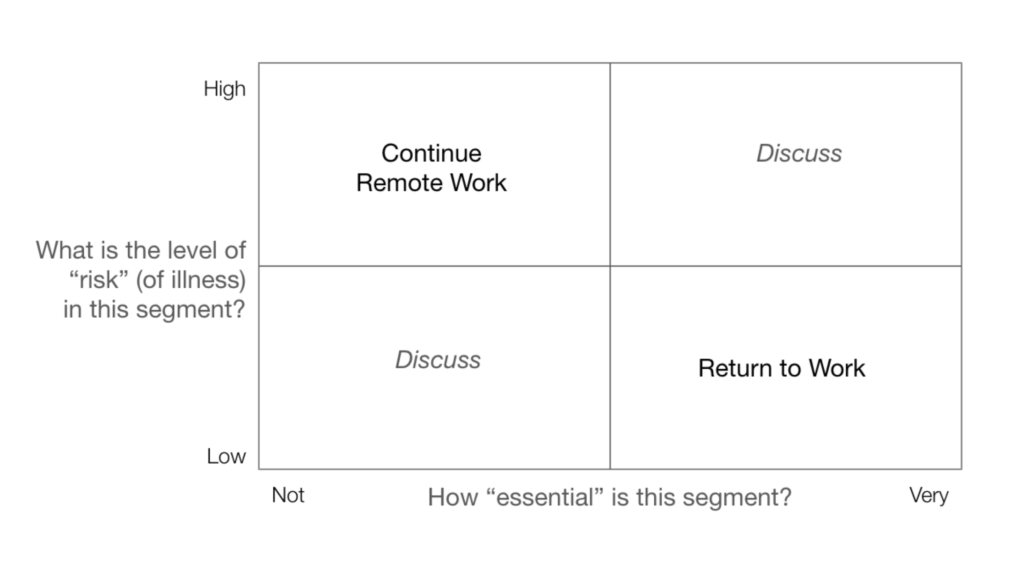
Ask yourself: Do you have any “high risk” employees in “essential” segments?
If you do, look to redefine your “essential” segments of employees into smaller sub-segments, noting that your benefit to returning will be reduced. Alternatively, consider revisiting the company-wide approach to RTW. Reasons that may sway you to do so would be the desire to maintain fairness and not discriminate against employees by age, family status, health, or other risk factors.
Define Phased Approach
For those employee segments that are “essential” and “low risk”, the next step is to define a planned approach to RTW. Protocols must be defined, including guidance on entrance screening, wearing of PPE, workspace modifications, cleaning and disinfection procedures, and more. There are several useful resources on this topic available at the end of this guide detailing these preparation steps.
Beyond your protocols, people, and processes are also central to a successful RTW. We recommend identifying local response teams that include members from HR and Operations. Worth noting that you want to be clear about the responsibilities of this response team and not ask they extend to health worker responsibilities that may be needed to successfully return employees to work safely. Additionally, clarify triggers and escalation procedures that would lead to a re-exit for some or all employees. Ultimately, the key question to ask is:
Can you keep employees safe when returning to work?
If the answer is, “yes” then you are ready to proceed. If the answer is, “no”, then protocols, people, and processes will need to be revisited.
Prepare your Organization
Training your workforce on the RTW protocols is crucial for this transition. The information needs to be clear, available in several communication channels, validated and confirmed before proceeding. Managers should use 1:1s with their direct reports to assess the comfort and confidence employees have in returning to work. This sentiment can also be identified in a brief pulse survey to employees. Sentiment should be viewed in aggregate, across segments, and then down to the individual level to determine:
Do employees have a “fear of return”?
If you identify “fear”, it’s a good signal to re-evaluate your phased approach to RTW. Identify the employee concerns and see if your company can reasonably address them. If not, re-evaluate the RTW strategy and decision with the rest of your leadership team.
Ready to Return to Work
If you identify employee confidence, then it’s time to move forward and begin executing your plan. However, the task force and leadership team should continuously monitor progress and evaluate risks and employee sentiment as changes in the status of outbreaks change regularly.
Additional References and Resources
- “The Back-to-Work Playbook” by Josh Bersin
- “Return-To-Workplace (RTW) Discussion Guide” by LifeLabs Learning
- “Return to Workplace Guide for Leaders” by Gartner
- “Essential COVID-19 Resources” by Think HR
- “Workforce Strategies for a Post-COVID-19 Recovery Workbook” by Deloitte
- “This twist on the four-day workweek could get people back to work without causing new outbreaks” by Fast Company
Stand against Injustice and Intolerance – Our Commitment to our Employees and Community
As CEO, my role is to listen and lead and right now, I need my team’s help more than ever. There is no training, playbook, or framework for this. As a leadership team, we are re-examining how we operate and focusing on ways we can contribute to change. It starts with ourselves, and we can and will do better at Reflektive.
In our team discussions, we’ve learned:
- In the past year, we’ve pushed for increasing the gender balance across our organization and reviewing gender pay equity on an ongoing basis. While we’ve made progress here (we’re 38% female/62% male), gender diversity is not enough.
- Empathy for ourselves, each other and community matters.
- This is not a singular initiative. We need to make diversity, equity, and inclusion an ongoing investment.
It’s up to us to commit to change, and here’s what we are doing:
- An open dialogue: Every voice is extremely valued. We’re holding company, departmental, and 1:1s meetings to allow our employees to listen to one another and speak their feelings. This is not a conversation for last week and next week. We’re committed to this on an ongoing basis.
- A break: We’re supporting our employees who would like to take time off, whether it’s to join peaceful protests or take a mental break.
- Awareness: Our team has circulated a number of resources including Anti-Racism and Black Lives + Communities Matter documents.
- Financial support: We’re making a corporate donation and matching employee donations. And with sales & marketing programs, we’re donating to organizations that support social justice in place of using gift cards as incentives.
- Our product: Our engineering and product teams are committed to building products that will allow employees to surface biases and for managers and HR to address and commit to action.
- Company action: We believe diversity, equity, and inclusion need to be embedded in company practices, and should be led by our Employee Success team in partnership with employees. We have a dedicated culture task force, responsible for embedding our values, and diversity, equity and inclusion into our daily behavior. This task force will help us with actions that the company will take.
- Individual action: We are in the process of determining the guidance we’re going to give our employees with respect to where they can invest their time and energy to make an impact.
We are aware this is not enough. This is a start, and I am proud of every employee for listening, speaking up, and committing to change.
Post by Greg Brown, CEO, Reflektive
Onboarding New Employees Remotely
Reflektive became a 100% remote workforce overnight. In addition to creating my own work-from-home setup, I’m onboarding our new head of corporate marketing along with two other members of our team in the coming weeks.
At Reflektive, our people and environment are uniquely friendly and inclusive. We strive to impart our collegial culture from Day 1. As such, many of our onboarding steps have been done face-to-face, and even those who worked from a home-office flew out to our headquarters for one or two weeks of onboarding. In this new working environment, we had to rethink our process to account for our newly remote workforce.
Our remote onboarding strategies include ways to:
- Create a sense of welcome, community and inclusion
- Accommodate our 100% digital work activities
- Establish communication channels that would otherwise happen at our desks
Here’s how we’re modifying our onboarding strategy for our newly remote workforce:
| Typical Onboarding Step | Virtual Onboarding Approach |
| Welcome email for employee informing them about their first day | – Rewritten with new details – Consider creating a personal video (shot on your phone) welcoming the new hire – Include new remote work expectations |
| Introduce new employee to colleagues via email | – Continue this activity – Add additional communication channel (Slack) along with more detailed bio and photo – Assign a virtual onboarding buddy to support the new hire in the first couple weeks. – Set up a meet & greet video for them |
| Work with IT to prepare new employee office equipment – laptop, email, and other logins | – IT to ship new laptops to employee’s home – *Glitch* Manufacturer is unable to ship new laptops. – New plan: Employee to use their personal computer – New instructions to setting up email and logins from a personal computer created and emailed to the employee for 7:30AM on their first day – Set up a meeting with IT at the start of the employee’s first day to troubleshoot any potential technical issues. |
| First-day meet & greet and office tour | – Set up a first-day morning video conference with team, along with other meet & greet video sessions for later in the day – Share home-work spaces on video conference – Send email and Slack communications introducing the new employee |
| Team lunch | – Order online lunch to be delivered during a virtual team meeting |
| New employee swag | – Ship to employee’s home as a welcome package – If your company swag is unavailable, order a nice care package from Amazon or another retailer. – Local gift cards are also a nice touch and a great way to direct resources to the businesses who need it most right now |
| Review and complete HR documents and policies | – New virtual meeting with HR team for all new hires – Add content about work from home policies and expectations – Collect documents scanned and sent via email by employee – All other forms and details remain the same |
| Company overview and introduction | – Continue with functional presentations from marketing, sales, engineering, finance, etc., now held virtually – Add new virtual session or a recorded video message with the CEO sharing more about Reflektive’s mission and vision – Set up a meet & greet with the most senior manager in your new employees’ organization for relationship-building and executive support |
| Get to know key stakeholders | – Provide list of key stakeholders to the employee — recommend they set up virtual coffee chats with these people – Share a virtual org chart with faces and names to help them understand company structure |
| Review company and department goals and plans | – Share company-wide priorities and objectives with goal management product – In one of our 1:1s, share how our team goals align with the company goals, and how the new employee supports these objectives – Schedule a session to define and enter goals into performance management solution |
| First manager meeting | – Review expectations for the role – Provide guidance to new employee to build a 30-60-90 day plan – Schedule daily 1:1s for at least two weeks to help your new team member acclimate. After the two-week period, weekly 1:1s help managers and employees stay aligned – Add a reminder to your calendar to check-in over Slack/Chat at least 1 more time during the day – Add 10 minute check-in at the end of Day 1 to answer any questions that may have arisen over the day |
| Get to know the product and services | – New employees to join trainings with new Sales hires on product overviews, pitch deck presentations, etc. This is a great way to learn from a seller’s perspective (as we all have to sell) and get to know more colleagues – Recommend useful reading and reference. Build a library of presentations, playbooks, videos and documents for new hires. – Share client stories so the new employee can understand the customer value of our solution and services. |
| Understand employee sentiment on onboarding experience | – Onboarding survey sent automatically to provide a pulse on the employee’s sentiment and progress – Encourage the employee to solicit feedback along the way from key stakeholders |
| Keep the enthusiasm high | – Be sure to share recognition frequently and publicly with the employee via Email, Slack and other channels used for employee communication – This helps build the new employee’s internal brand and sets them up for early success |
At Reflektive, we are using our product to help develop our virtual onboarding plan. Below are a few useful examples to share for our Reflektive customers:
Organizational Chart
As you introduce new employees to the organization, your organizational chart with faces, names and titles will be more important than ever. This is a neat feature in Reflektive that not too many people know about. Since we integrate with HRIS systems like ADP, Workday, SuccessFactors, Namly and BambooHR, we can easily pull organizational information for all employees to see.
From an employee’s profile, click the org chart icon below their picture and next to their title.
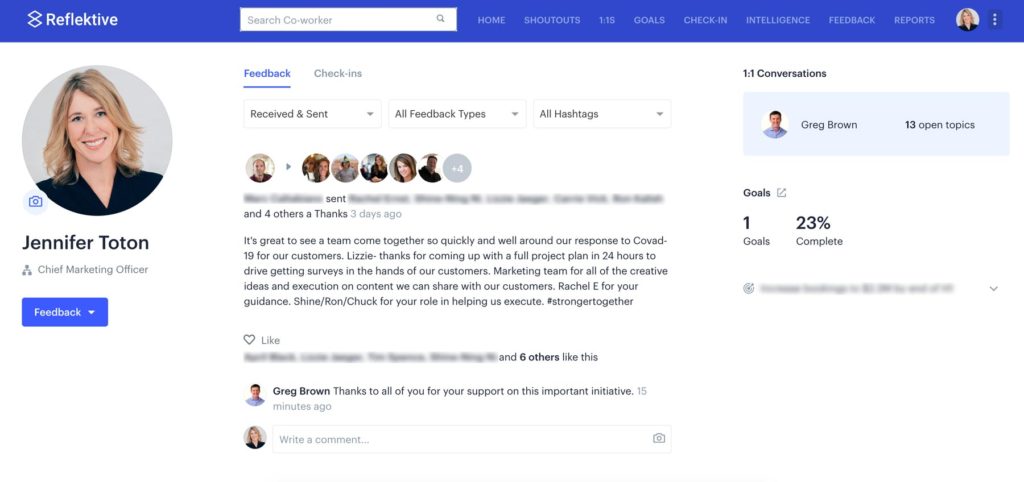
And then navigate from team to team across the company’s organization with a click.

Company Goals
Use Reflektive to share company goals. This feature not only is a great communication tool, it also helps to drive alignment on key organizational priorities.
Click on the Company goals, then expand to see the laddering of goals and subgoals
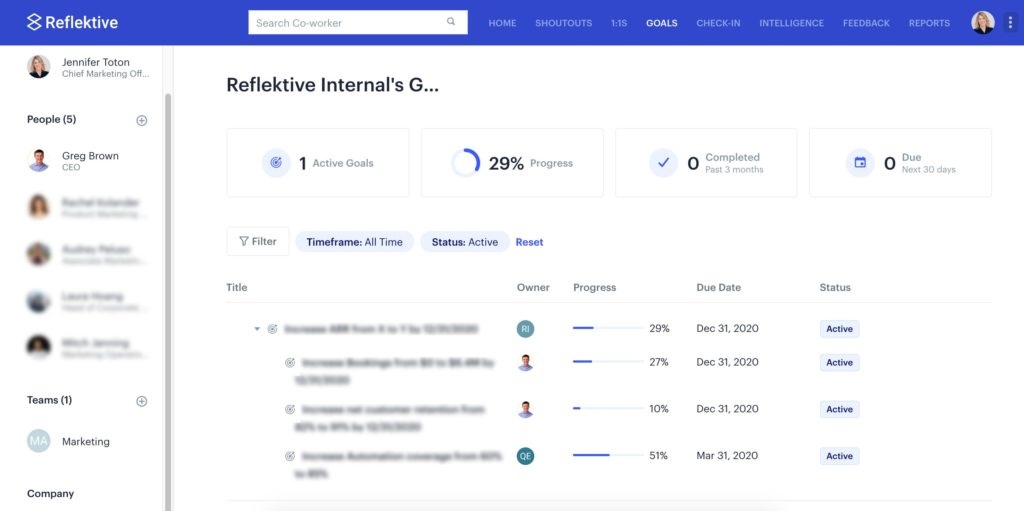

The org chart view is useful here too, which displays when you click the “View alignment” icon . Now you can share how each team member supports company goals.
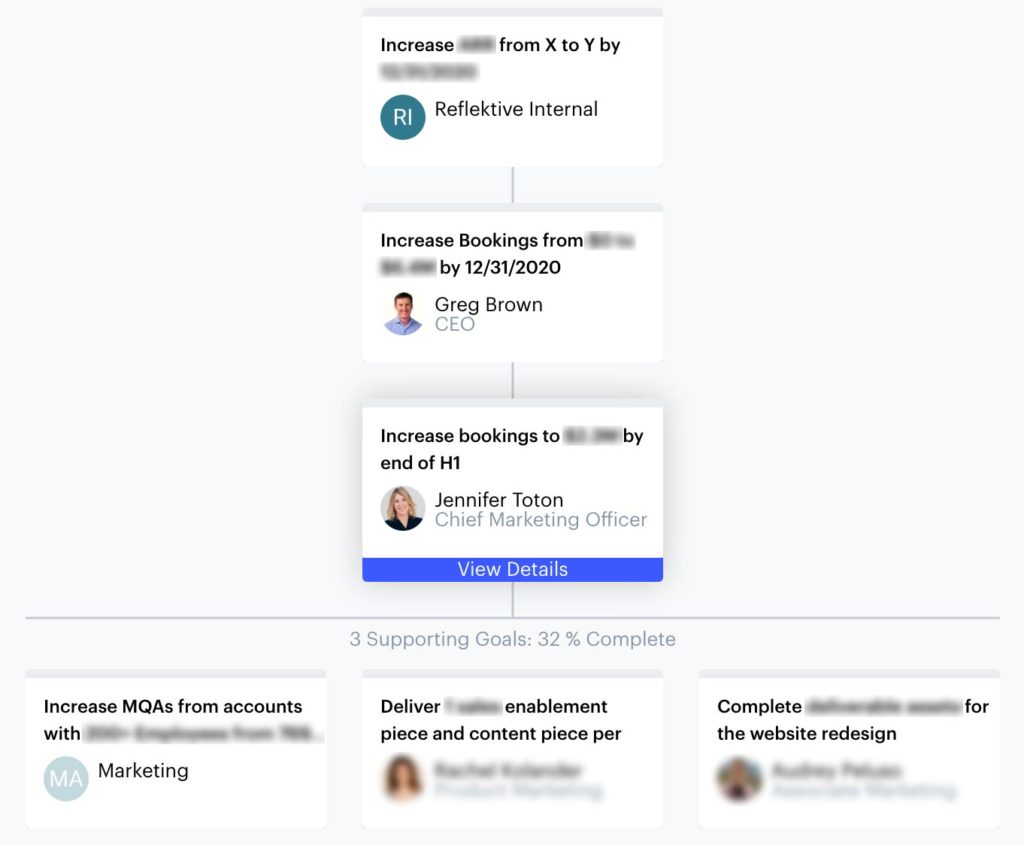
Reflektive’s goal management product is also a great segue to talk about goal setting and accountability at your company.
Flexible 1:1s
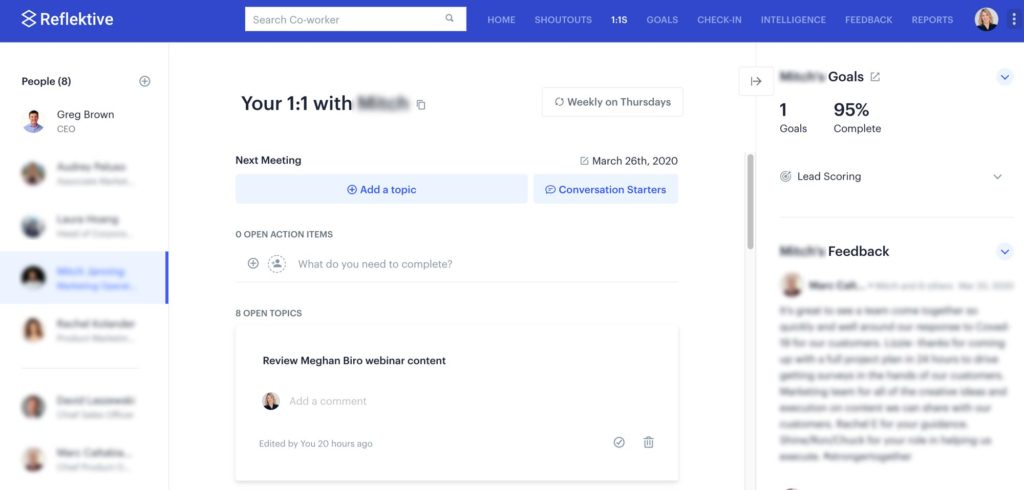
To boost your new hire’s productivity, we recommend regular 1:1s, scheduled at a high frequency. Reflektive’s 1:1 tool is an intuitive product with the following capabilities:
- Gmail, Slack, MS Outlook, and MS Teams Integrations
- How they help: Enable employees to easily add and see 1:1 agenda items, right in their favorite workplace tools
- Reflektive Best Practice: I pull up my 1:1 agenda items in Gmail shortly before my meeting so I have better context on what we’ll be discussing
- Action Items
- How they help: Visual reminders of what you need to complete to support your new hire
- Reflektive Best Practice: Once my direct report and I align on next steps during our 1:1, I immediately add it to my Action Items. I set aside time each week to review and follow-up on my Action Items.
- Conversation Starters
- How they help: Drive meaningful conversations that an employee may have difficulty introducing, such as career conversations and coaching opportunities.
- Reflektive Best Practice: I use Conversation Starters if I notice that my direct report and I haven’t added many agenda items to our 1:1. If it’s a light week, we can catch up on career goals and share feedback on different projects.
With my 1:1s, I always follow a 4Ps approach: People, Processes, Projects, and Personal. I ask questions in each of these areas to ensure we are probing deeply across my team member’s progress. And as topics are covered you can move them off your agenda list, or reorganize your list to talk about what’s most important first.
Here’s what our 1:1s product looks like:
Onboarding Survey
If you don’t have an automated onboarding survey already set up, work with your HR partner to launch it. Our survey template covers the new hire’s recruiting and orientation experiences, as well as company and manager communication. Some questions include:
- “I received helpful company information during onboarding”
- “I understand my company’s goals”
- “I feel welcome and part of the team”
You can modify the template to add new questions, including ratings scales, free text, and multiple-choice response types. What’s more, you can customize the timing of the survey so that it is delivered at the right point in the employee journey, whether that’s 30 days, six weeks, or two months after the hire date. Once you select the timing, onboarding surveys will be automatically sent to all new hires — no manual intervention needed from the HR team.
Company-Wide Recognition
Recognition is important to keep new employees motivated, and help them feel connected to the company. No longer can you share a “great job” in your team meeting or all hands session. We are using Reflektive’s recognition feature more than we ever have. It’s a great way to give kudos or congratulate a job well done. Giving thanks is super easy – you can do it from Reflektive, Gmail, MS Teams, MS Outlook, and Slack. For extra bonus points, create an incentive program and encourage everyone to step up their recognition game!

Anytime Feedback
Beyond recognition, honest feedback can be invaluable in an employee’s early days at the company. Be sure they know how to easily solicit feedback after key milestones. As a manager, you can reach out directly to key stakeholders to get their unbiased feedback too.

Be sure to check out our online community and our resources section of the website to get more information on best practices and how to’s on the above recommendations.
If you’re looking to craft a thoughtful onboarding plan for your remote employees, please reach out here .
Does Having a Bad Manager Mean that You Will Become One?
What makes a bad manager is a question that has plagued managerial studies for years. The question isn’t about the characteristics of a bad manager — bad manager traits are pretty easy to spot. Instead, the question is more about whether exposure to a toxic manager encourages an employee to develop bad manager traits when they attain supervisory positions.
It’s a question worth asking. Bad managers can lower productivity, reduce morale, and drive away talent. Roughly 50% of employees would leave their position if they felt unappreciated by their manager.
Bad Management and the Cycle of Dysfunction
The concern that bad management can spread in a never-ending cycle comes in part from decades of psychological studies into how humans learn behavior. Humans learn by watching and mirroring the behavior of parents and other role models. If role models are negative (and bad managers can be highly toxic role models), the theory goes that such learned misbehavior will be perpetuated. For instance, many psychological studies have shown that children who experience high levels of parental conflict are more likely to divorce as adults.
As the theory of mirroring entered popular culture, it became oversimplified into a pop psychology equation. For example, media outlets took the above-mentioned studies, boiled them down, and promulgated the misinformation that when parents divorce, their children are more likely to divorce, completely eliding over what the studies had actually proven: it’s exposure to high levels of parental conflict over time, not divorce, that increases the risk of divorce in later life.
Role models influence human behavior, but we’re not necessarily doomed to make the same mistakes in perpetuity. While some evidence supports the notion that people reproduce the behavior of role models, other studies indicate otherwise.
DOWNLOAD THE E-BOOK: 51 Hacks to Become a Better Manager
Mirroring or Disidentification?
A study into the likelihood of adult survivors of childhood abuse becoming abusive parents offers an alternative. Survivors of abuse can become abusive parents themselves, or they can “disidentify” with their parents, and become determined not to repeat the cycle of abuse.
This ability to disidentify with toxic role models means that no, you’re not doomed to become the manager you hated during your internship. When Harvard Business Review examined real work settings in a variety of Indian organizations and industries, they found exposure to a bad manager resulted in a 12% increase in an employee’s disidentification with that manager. In other words, the employee was less likely to display bad manager traits.
Furthermore, the study noted that employees who have “a strong moral identity” had a 14% increase in disidentification. A similar study by the Journal for Applied Psychology yielded similar results. Exposure to a bad manager does not automatically result in a new generation of toxic managers. This is good news for businesses, as people tend to leave managers more frequently than companies.
This isn’t to say that exposure to a bad manager doesn’t have an effect. Employees unlucky enough to experience toxic managers often do learn from bad bosses — they just learn to identify the characteristics of bad managers and actively work to ensure they don’t display those traits themselves.
If you’re currently suffering under bad management, take heart. Being concerned that you might become your bad boss in the future is a sign you’re aware that they’re toxic, so you can make a commitment to not repeat their mistakes. You’re not your boss, and you don’t have to be. If anything, you’re probably learning how to be a good manager by identifying and rejecting the traits that make your manager toxic.
DOWNLOAD FREE E-BOOK: The Ultimate Guide to Real-Time Feedback
Thrive on Transparency: How to Increase Honest Performance Feedback
Giving constructive feedback is one of the most difficult aspects of the employee/management relationship. Managers want to provide honest performance feedback without upsetting employees. Rather than risk confrontations and hurt feelings, some managers retreat behind the shield of bland, generic performance reviews, generalizations, and insincere praise — softening feedback to the point it becomes useless.
Employees can also make it difficult to have honest performance conversations. To avoid negative feedback, many an employee positions him or herself in the best possible light during performance reviews or self-assessments. As for giving honest feedback to the boss, employees often shy away from the very idea, fearing the boss might take feedback the wrong way and retaliate, with consequences for career advancement, earning power, and even job continuation.
When these habits are allowed to flourish, honest performance feedback becomes all but impossible in the manager/employee relationship. Candid, honest dialogue vanishes, and both organizational and individual development suffers.
DOWNLOAD FREE E-BOOK: The Ultimate Guide to Real-Time Feedback
The Power of Discomfort
Candid, honest performance discussions make people uncomfortable — there’s no question about it. But it’s within the hard conversations — the ones people shy away from — that the potential for real dialogue and improvement lies. Employees who receive honest feedback are typically more engaged. Managers who receive honest performance feedback are generally more effective. Honest performance conversations are valuable, productive discussions. Here are a few suggestions to take some of the discomfort out of the equation and move toward a more candid, empowering employee/manager relationship.
Build Trust
Honesty requires trust. Without trust, both sides of the conversation are unlikely to react well to constructive criticism. Building a foundation of trust and mutual respect is vital to honest performance discussions.
Trust isn’t something that develops overnight. It takes time and continuous effort to build a strong, trusting relationship. Managers can begin by letting employees know they’re valued and prefacing any constructive criticism by assuring employees managers only want to help them achieve their full potential.
Hold Frequent 1:1 Meetings
Confining feedback to annual performance reviews makes it difficult to develop the trust needed for honest performance conversations, if for no other reason than the fact that neither party will be able to accurately remember everything that happened in the previous 12 months.
Instead of limiting feedback to annual reviews, switch to monthly 1:1 meetings and a system of real-time feedback. Most employees prefer immediate feedback, as it helps them improve the outcome of their current tasks. 1:1 meetings also build comfort levels in the manager/employee relationship, as both parties become accustomed to interacting and discussing a wide range of topics.
SEE ALSO: The Ultimate Guide to One-on-Ones
Acknowledge the Discomfort
Talking about how giving and receiving feedback makes people uncomfortable helps get the issue out into the open. Discuss the ways people react to feedback and the advantages of honest performance conversations. Acknowledging the problem helps both manager and employee move forward.
Keep Honest Performance Conversations Separate from Other Issues
Employees, especially, find it difficult to have transparent discussions about personal performance on the same agenda as compensation, promotion, and job security. This makes perfect sense — who wants to admit they need to improve their work performance in the same meeting where a financial raise is on the line? Keep feedback discussions separate from other work-related issues. Again, regular 1:1s make it much easier to focus a meeting on performance alone without trying to cram everything into one annual meeting.
Really Listen
Actively listening to someone else is an important soft skill. If you’re already formulating a response before the other person has finished speaking, you aren’t truly focused on what they have to say. Take the time to really listen to the other person, and you’ll both experience a more fulfilling, productive conversation.
Practice Emotional Intelligence
It’s not just what we say that determines the success or failure of an honest conversation. Body language and emotions also play a role. Learning to read emotional signals — and identify them in yourself — is an important component of emotional intelligence, as is validating and empathizing with the other person’s point of view.
Honest performance feedback benefits managers, employees, and their organizations. It may sometimes make people uncomfortable, but the ability to share a candid discussion is vitally important. With honesty and a commitment to act in each other’s best interests, coworkers can move mountains.
First-Time Managers: How to Get Started
After years of hard work, you’ve just been promoted to a managerial position. Chances are you’re feeling proud, excited, and probably more than a little nervous. How will you handle conflicts with team members? How often should you meet with your direct reports? Will your team respect you and trust your leadership?
Ideally, first-time managers have been properly mentored and prepared for their positions, but not every company has a leadership or new manager training program. Often, first-time managers find themselves learning on the job with relatively little guidance. If this describes the position you’re in (or if you just want to explore management strategies), the following checklist for first-time managers will help you adapt to your new leadership role.
Work for Your Team
It’s easy for first-time managers to assume their team works for them, but the opposite is true. As their manager, you work for your team. It’s your job to advocate for them, mentor them, and ensure they’re working in a culture that encourages productivity and performance. Everything you do is for the team.
Employees can choose to take a “me first” approach to work, but managers don’t have that luxury. For first-time managers, switching to “servant leadership” can be a difficult process, but one that ultimately builds trust and helps you foster leadership skills in promising employees.
Examine Your Skill Set
You have a skill set that made you stand out from your peers and proved impressive enough that your supervisors trusted you with a management position. Unfortunately, the skill set you developed as an employee may not be the one you need as a first-time manager. Find opportunities to learn more about conflict resolution, emotional intelligence, and other “soft” skills effective managers use every day. Check to see if your company is willing to pay for a new manager training program, and read up on different management styles and strategies.
Don’t Act Like You Know Everything
First-time managers often assume they must have all the answers at their fingertips and may feel stress and frustration when they’re inevitably confronted with questions they can’t answer. Remember, your team members know their jobs better than you do, so take their advice and feedback seriously. Should a team member approach you with a question you can’t answer immediately, tell them you need some time to research the issue and get back to them.
Don’t Be the Department Hero
First-time managers are usually acutely aware of their responsibilities. They are, after all, the heads of their departments. This can lead to the temptation to try and resolve every issue personally, swooping into every situation like the office superhero.
While understandable, this habit is unsustainable. You’re only one person and can’t be everywhere at once. An insistence on being the one who oversees everything turns first-time managers into departmental bottlenecks, as every little detail requires managerial approval before moving forward. You’ll quickly wind up stressed out and overwhelmed — and, far from appreciating your help, your team will feel micromanaged.
It’s far better to trust your team to resolve issues and only step in when necessary or when staff requests managerial aid. As for any mistakes the team may make, most will be minor, and all provide valuable learning and growth opportunities.
Learn to Delegate
Delegation is a vital part of management. Accept the fact that you cannot control everything, assign responsibilities to your direct reports, and let them fulfill these obligations as they see fit. Doing so builds trust, gives employees ownership of important tasks, and allows you to guide the department without running yourself ragged.
Delegating doesn’t come easily to first-time managers who were accustomed to taking full responsibility for tasks in their previous, non-managerial positions, but it’s an important skill to learn. Seek advice on delegating from your own mentors or in first-time manager training programs.
Sell, Don’t Tell
Almost everyone has had a team leader who issues orders from on-high and brooks no contradictions or suggestions. The percentage of people who respond well to this managerial style is approximately zero. People don’t like to be told what to do.
For most managers, persuasion works better than command. Ask team members for input on important decisions, and give them chances to influence solutions. In cases where you have a specific desired outcome in mind, ask staff pointed questions to lead them to the same conclusion you’ve made. People who feel they’re involved in the decision process are more willing to work towards mutually agreed-upon goals.
Establish Clear Objectives
Not setting clear and specific objectives is a common mistake among new managers. Strive to be straightforward, unambiguous, and precise. “We’re going to cut energy costs this quarter” is a vague objective which lacks direction. In contrast, “We will cut energy costs by ten percent this quarter” gives the team a specific goal to achieve. Should the team fail to achieve the goal, you still have a benchmark you can use to determine how close you came to success and which acts as a launchpad for discussions on how to move forward.
Support and Empower Your Direct Reports
Direct reports are your main points of contact with your department. Empower them by making them the owner of 1:1 meeting agendas. Doing so gives direct reports a sense of ownership over their role in the department and encourages them to think critically about that role. Whenever possible, encourage their autonomy and only step in if their priorities are misaligned with those of the department or company.
SEE ALSO: The Ultimate Guide to One-on-Ones
Make Yourself Dispensable
Ask yourself this: if you were away from work for three months, would your department run at normal levels of efficiency? That’s the ultimate goal of management, to make yourself as redundant as possible.
No one achieves this goal overnight. Doing so requires clear communication, skillful delegation, and fostering trust among your team. The best managers are those who know they can trust their department to run well in their absence.
Brush up on Your Emotional Intelligence
Knowing how to read the emotional state of a team member is an important “soft” management skill and a valuable tool when dealing with interpersonal conflicts. Emotional intelligence describes the ability to understand and control your own emotions while recognizing and valuing the emotions of others. It’s a skill that’s equally important whether you’re dealing with your team or members of the executive team.
Mistakes are Inevitable
It’s a hard lesson for first-time managers to swallow, but mistakes and losses happen. Your team will stumble. Your department will miss goals and make mistakes. This isn’t a sign you’re failing as a manager — it’s simply part of doing business.
What counts isn’t whether your department suffers a loss; it’s how you respond to losses. As a manager, you don’t have the luxury of feeling down in the aftermath of a departmental disaster. Your emotions must take a back seat to the emotions of your team. You’re their cheerleader — picking them up when they’re down, encouraging them to do better, and celebrating their successes.
Obviously, you want as few losses as possible, but be prepared to support your team when setbacks happen, even if you’re feeling discouraged yourself.
Listen to Your Team
As a manager, your greatest resource is your team. Your team knows more about their individual roles, challenges, and responsibilities than you ever will. Take advantage of this knowledge: listen to their experiences, concerns, and feedback. In doing so, you’ll gain deep insight into your department and how it runs.
Treat Team Members as Individuals
“Treat others as you want to be treated” isn’t as effective a management strategy as you might think. It’s much more beneficial to treat others as they want to be treated. Your goals, values, and objectives may be quite different from those of a team member, and what motivates you may have no bearing on his performance.
Try to assess situations through your team members’ eyes. What type of communication are they most comfortable with? What are their personal life goals? How do they prefer to approach tasks? How do they like to be recognized for their accomplishments? How do they prefer to receive feedback? Treating each person as an individual demonstrates you care about their well-being, rather than assuming your feelings and values are universal.
Share Credit, Take Blame
First-time managers should accept their position means they are responsible for everything that goes wrong. When a team member flubs an important task or the team fails to meet an important goal, you’re the shield that stands between your team and any blowback from higher up the managerial hierarchy.
Leadership isn’t just about shouldering the blame for department missteps; it’s also about sharing credit. When your department has a success, your job is to give credit to the team while advocating for them to upper management. Always credit your team with the wins, rather than yourself.
Find a Mentor
A significant portion of your role as a manager is mentoring team members and helping them develop their skills and careers. This is a serious responsibility, but don’t let it prevent you from working on your own career progression.
Find a mentor who’s further up the management chain than you and ask her for advice concerning both your current challenges and your future career. If this isn’t possible, seek out additional management training, and look for mentors from outside your company, either online or through local networking events.
Provide Feedback
Employees value real-time feedback and regular check-ins; both help them evaluate how well they’re performing and address any concerns. Using employee engagement tools helps provide immediate feedback, as do regular 1:1 meetings.
No first-time manager’s checklist will cover every challenge you’ll meet in your first few months as a department leader. As more experienced managers will attest, management requires a commitment to constant improvement, experimenting with new strategies and evolving to meet new challenges. Hopefully, the advice given above will help make your first months as a new manager a little less overwhelming. Management isn’t always easy, but it’s always interesting!
DOWNLOAD THE E-BOOK: 51 Hacks to Become a Better Manager
Webinar Recap: Strategies for Smarter 1:1 Conversations with WSJ Best Seller Julie Zhuo
Reflektive recently had the pleasure of hosting a webinar with Julie Zhou, VP of Product Design at Facebook and author of the Wall Street Journal bestseller The Making of a Manager, on the topic of 1:1 conversations. During the engaging conversation, Zhou discussed the following:
● How to have smarter 1:1 conversations with direct reports and peers
● How to establish trust among direct reports and team
● Her philosophy on feedback
● What the ideal 1:1 looks like
● Strategies to improve 1:1 formats
The complete webinar is available here. Below is a recap of Zhou’s thoughts.
The Making of a Manager
Like many, Zhou experienced two very different emotions when she first became a manager: elation over her new position and a deep concern, best described as “What am I doing?” After several years in management, she began to blog about the challenges of leadership. She quickly discovered that many of the issues discussed in her blog resonated with her readers, whether she was talking about the perils of imposter syndrome or how best to recruit and retain talent. Her readership now numbers in the hundreds of thousands.
Like many first-time managers, Zhou learned through a process of trial and error. Early in her career, she searched for a resource to guide her through the managerial learning process; while she found a multitude of helpful books for experienced managers, no introductory field guide for the first-time leader existed. The Making of a Manager is the book Zhou wanted at the start of her career: an overview of the basic principles and strategies a new manager needs for success.
Defining a Manager
Before taking a deeper dive into Zhou’s philosophy, we asked her to define a successful manager. Her response was, on the surface, simple: a great manager gets great outcomes from his or her team.
To achieve this goal, a manager needs to understand the team’s objectives, remove obstacles standing between the team and said objectives, and help them attain their goals faster — with higher quality and in a sustainable manner. To do so, the manager must focus on her most important resource: people.
Zhou offers a school’s hierarchy as an analogy. The principal acts as the manager of the school. The school has a clear objective: to prepare children for the future by providing them with the skills and knowledge they’ll need for the next stage in their journey, be it graduating middle school or entering college. The principal’s job is not to teach children directly; his mission is to support teachers by providing them with the right resources, growth opportunities, and assistance.
Trust and Management
Zhou considers trust an essential element in the employee/manager relationship. She notes it’s the people we trust who tend to be the most influential in our lives, and acknowledges how difficult it is to trust someone you don’t believe has your best interests at heart.
In this regard, the manager/employee relationship is no different than any other personal relationship. Managers must win employee trust, especially if headway is to be made in 1:1 meetings. An employee who knows his manager has his best interests at heart is more likely to ask for advice or explore opportunities for growth during meetings. He’ll be willing to tell you when he feels uncomfortable and needs help.
Employees who don’t trust you won’t be willing to express such openness, and growth is only possible when both sides are at ease being vulnerable with each other.
Coaching
A coach is someone who helps others improve their performance. A coach is an advocate, someone who has your back and wants you to succeed. Zhou considers coaching one of the most important aspects of management.
Given the structure of many organizations, employees often see managers less as coaches and more as judges. After all, your manager holds power over you. She’s the one who determines which projects are a priority, decides who takes the lead on projects, and who gets promoted. She’s even the one who determines whether you have a job, or if you’ll be laid off or terminated.
To placate the “judge,” employees put on their game faces. They hide any signs of vulnerability and avoid asking for help or discussing what troubles them. Doing so robs them of the opportunity to be coached.
Athletes don’t hide their weaknesses from their coaches; a coach needs to understand an athlete’s weaknesses to help him or her improve. It’s the same with employees. Only by understanding your employees’ weaknesses, problems, and aspirations can you help them improve. Again, trust is your main objective. When employees feel safe being vulnerable, they will seek the help you can provide.
1:1 Meetings and Conversations
1:1 meetings offer opportunities to build connections with employees and strengthen trust. Zhou offers several strategies for improving 1:1 meetings, including:
● The meeting should focus on the direct report, not the manager. The direct report should be the one who sets the agenda. Tip: Asking for the agenda a day in advance helps you prepare for the meeting.
● The most productive meetings are often the slightly awkward ones, where you and the other person discuss points that make one or both of you vulnerable and a little uncomfortable.
● Use the meeting to better understand each other.
● Keep status reports separate from 1:1s; use 1:1 meetings to explore topics that can’t be covered in an email, text or hallway encounter.
● Take the time to check in on how the employee is doing. Is the employee stressed or confident? What’s going in the employee’s world outside of work?
● Explore the other person’s career goals and aspirations. What does six months, a year, or three years of satisfying work look like to the employee? (Note: “I’m not sure” is a perfectly acceptable answer).
● Ask the employee how you can help her overcome obstacles and achieve goals.
● Ask for feedback — how are you doing in your role as a manager? Are there ways you can help the employee you haven’t considered?
The goal is for the other person to leave the meeting feeling she’s learned something, been inspired, or otherwise made great use of the meeting time. If all your 1:1 meetings are pleasant but unmemorable, it’s a sign you need to dig deeper. Ideally, meet with your direct reports for at least thirty minutes a week.
Offering Feedback
Zhou recommends keeping at least fifty percent of feedback positive. Not only are you reinforcing the employee’s strengths, but you may also help them identify strengths and talents they hadn’t realized were important and valued. While employees often already know they’re doing well in a particular area, it never hurts to tell them so.
Much of the webinar, naturally enough, focused on relaying tough feedback to other people. First-time managers, in particular, often struggle to deliver critical feedback without damaging the employee/manager relationship.
If you already have a strong relationship with the employee, he or she is unlikely to feel threatened by tough feedback. If, however, you’re still building a foundation of trust, Zhou recommends prefacing any negative feedback with the assurance that you, as a manager, have the employee’s best interests at heart. Tell them your intent is to help them improve as an employee and then deliver the feedback. Explain how the employee’s actions made you feel (were you anxious, stressed, or disappointed?), and follow up by asking how you can help resolve the issue.
Check out the entire webinar to hear Zhou discuss these topics in more detail. Her philosophy of trust-based management isn’t just helpful for first-time managers — it’s intriguing listening for anyone in a leadership position.
5 Tips to Prepare for a Career-Growth Conversation
With companies increasingly concerned with employee engagement, career development meetings have become more common. Career development itself has changed significantly over the last few decades. Gone are the days where a career path was a straight line up the corporate ladder; today’s employees favor opportunities to increase their skills and usefulness as much as (or more than) promotions.
SEE ALSO: 51 Hacks to Become a Better Manager
The modern workplace offers ample opportunity for skill-based career growth. Today’s companies tend to have a flatter structure, with more importance given to collaboration between teams than direct lines of command from the CEO on down. An employee can build a solid, rewarding career without any vertical movement–an ideal situation for those employees who have no interest in assuming managerial positions.
Career development meetings provide clarity and guidance to help employees reach career goals–when handled correctly. While managers play important roles in career development, the primary responsibility lies with the employee. A little preparation will help you get the most out of your next career meeting, whether it’s part of your annual performance review or a specially scheduled meeting with the boss.
Memory is Fallible: Take Notes
Even if your manager favors frequent, informal one-on-one meetings, you’ll only have the opportunity to discuss career development a few times a year. Will you be able to accurately remember all your accomplishments and concerns between meetings?
Keeping a career journal ensures you’ll have accurate information at your fingertips when you meet with your manager. It’s an excellent way to recap your accomplishments, record potential career development discussion questions as they come to you, and note areas where you need to develop your skills. Your journal can be a Google Doc, a note on your phone, or a physical book–all can be used to make sure you don’t miss anything important from one career development meeting to the next.
Set the Agenda
The tone of career development meetings is generally set by the employee rather than the manager. Take full advantage of this by creating an agenda before each meeting. Use your career journal to identify points for discussion, including updates on any career development plans decided on during your last meeting, your recent accomplishments and triumphs, and any areas where you see a need for improvement.
Send the agenda to your manager in advance of the meeting, and ask him if he has anything to add to the agenda. Doing so demonstrates your initiative while also considering his perspective.
Anticipate Questions
Your manager will have her own thoughts, suggestions, and opinions about your career path. Try to anticipate her concerns before the meeting. Consider the types of questions she’s likely to ask and practice answering them. Suggest career development discussion questions as part of your agenda, so you both know what topics will be discussed.
While it sounds silly, practicing your responses with a friend as your audience helps you get your thoughts in order and prepare for the meeting. Practicing in front of a mirror also helps–and gives you a chance to check your body language.
Understand the Three C’s
To get the most out of your career development meeting, consider the three C’s: context, congruence, and competencies:
Context requires you to examine your career aspirations in light of your organization’s culture. Use career discussion meetings to find out what it takes to move forward in the company, who assigns staff to projects, who makes promotion decisions, and how to best focus your efforts.
Congruence refers to how well your career goals mesh with company goals. When an employee’s career path complements company goals, everyone wins. Managers are much more likely to support your aspirations if they can see how the company benefits.
Competencies are the skills and knowledge you need to further your career path. Identifying skill gaps, seeking developmental opportunities, and requesting constructive feedback on your work all help build competencies.
DOWNLOAD THE E-BOOK: 51 Hacks to Become a Better Manager
Define Your Own Success
Career development meetings help you define and refine your personal career goals. Your definition of career success may be very different from a coworker’s. While some people still work their way up the corporate ladder and dream of management positions, others want to develop a skill set, learn more about other areas of the organization, or develop conflict resolution skills to better manage conflict within their team. Your career path is your own, and as long as you’re applying your skills in a way that benefits the company, your manager should support it.